

Taming the Open Air: How Weather and Wind Shape Your Festival Sound
Why Outdoor Festival Mixes Disappear into Thin Air
Open-air festivals deliver a physical kind of excitement that indoor venues rarely match. The kick drum travels across a field, a vocal rises above thousands of people, and the audience feels the scale of the performance in every direction. Yet that freedom also creates a Client Challenge for the mix, removing the reflective walls, ceiling, and predictable acoustic boundaries that help an indoor system build energy. Outdoors, the mix must create its own sense of focus while competing with distance, weather, crowd movement, and a constantly changing atmosphere.
Wind gusts can shift the apparent arrival of high frequencies from one song to the next. A warm afternoon may produce one propagation pattern at soundcheck, then an evening temperature inversion can alter coverage once the headline set begins. Dry air absorbs high-frequency energy over long throws, making cymbals, consonants, and musical detail fade before the low end does. These conditions demand more than an indoor mixing approach with extra volume. They require atmospheric awareness, deliberate system design, and a Front of House strategy that keeps the musical flow intact from the front rail to the back fence.
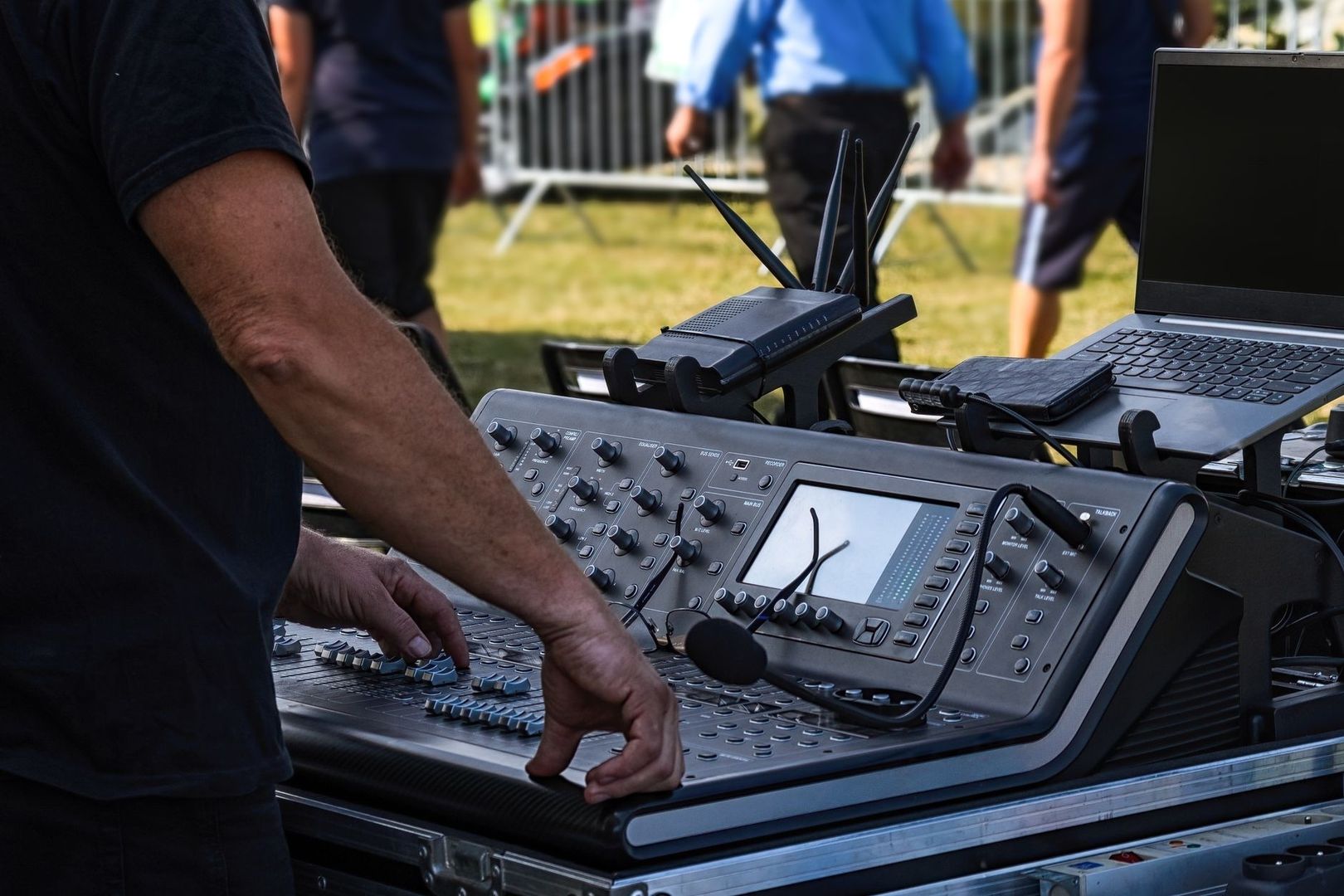
The Invisible Audio Saboteurs Above the Crowd
Wind does not simply push sound sideways. It changes the effective speed of sound through the air, and that change varies with height because wind speed usually increases above the ground. This creates a velocity gradient, or wind shear, across the vertical path of an array. Downwind, the upper part of a wavefront can travel faster than the lower part, bending the wave toward the ground and often improving long-range audibility. Upwind, the opposite curvature can lift the wave away from the audience, leaving distant listeners with a thinner, less stable mix.
The effect becomes increasingly important across a large festival field. A gentle breeze may be almost irrelevant over a short distance, yet meaningful across a 200-metre or longer audience area. Gusts also introduce time-varying changes rather than one stable correction. Research on outdoor propagation, including atmospheric acoustic studies published in the Journal of the Acoustical Society of America and international propagation standards such as ISO 9613-2, demonstrates why wind differences at increasing altitudes can warp wavefront trajectories. The practical lesson is clear: array prediction should be treated as a starting point, not a permanent guarantee.
Temperature creates a second moving target. During a hot afternoon, air near the ground may be warmer than the air above it, producing one refractive pattern. After sunset, the surface cools while air higher up remains warmer, creating an inversion. This can bend sound back toward the ground and allow low-frequency energy to travel farther than expected. The result may be powerful bass at the rear of the site, increased interaction between delay zones, and a greater risk of low-end build-up in areas that sounded balanced during the afternoon.
High frequencies are particularly vulnerable to atmospheric absorption. Dry air removes more upper-frequency energy over distance, so the attack of percussion, the intelligibility of speech, and the edge of guitars may soften even when overall SPL appears adequate. Humidity changes the absorption profile, but humidity should not be treated as a simple universal boost control. Raising high-frequency EQ aggressively can increase harshness near the main system while doing little for the furthest listeners. Corrective decisions should be based on measurement at representative audience positions.
- Measure wind direction and speed at several heights when possible, not only at the mix position.
- Track temperature and humidity continuously from setup through the final set.
- Expect the most audible changes in high-frequency detail, vocal intelligibility, and low-frequency overlap between zones.
- Use prediction software, delay-zone measurements, and listening walks together rather than trusting any single data source.
Atmospheric Impact Breakdown on Sound Frequencies
Different parts of the spectrum respond to weather in different ways, which is why a single master-bus correction rarely solves an outdoor coverage problem. Sub-bass is comparatively resistant to atmospheric absorption, but it travels widely and can become excessive as evening conditions stabilize. Midrange energy carries much of the vocal and musical identity, so small coverage changes can affect clarity and emotional impact. High frequencies provide definition and transient detail, yet they lose energy most readily over long, dry throws.
Front of House should therefore compensate with restraint and observation. A tonal change that improves the rear fence can make the front rows bright or fatiguing. Use system processing, array shading, delay-zone levels, and carefully chosen equalization as separate tools. The goal is not to make every position identical, which is rarely possible outdoors, but to keep the musical balance consistent enough that the audience experiences the same groove and message throughout the site.
| Weather factor | Most affected range | Practical sonic impact | Useful response |
|---|---|---|---|
| Temperature drop | All frequencies, especially long-range low end | Propagation speed changes, delay timing shifts, and bass may carry farther | Recheck delay timing, sub-to-main alignment, and zone interaction |
| Crosswind or changing wind shear | Upper mids and highs over long distances | Uneven vocal presence and shifting tonal balance across the field | Monitor audience positions, adjust coverage and delay levels conservatively |
| Low relative humidity | High frequencies | Reduced air absorption is not guaranteed in every band, but perceived detail can change substantially with distance and conditions | Verify HF response at distance before applying broad EQ boosts |
| Evening inversion | Low and low-mid energy | Greater far-field carry, possible rumble or overlap between systems | Control sub deployment, reduce unnecessary spill, and reassess environmental levels |
Subwoofer Strategies That Beat Boundary Loss
Outdoor subwoofer design begins by rejecting the idea that ground stacking automatically provides a free, universal 6 dB gain. Boundary measurements can be misleading because the ground plane itself influences the result. A listener or measurement microphone close to the boundary may receive reinforced energy, while a standing audience member several metres away experiences a different relationship between the source, floor, and listening height. Practical tests discussed by field-oriented subwoofer research show that flown systems can perform competitively when height, venue depth, and listening geometry are considered.
Ground stacks remain extremely useful. Their propagation is parallel to the floor, which can reduce ground-bounce comb filtering and simplify coupling with the audience plane. Flown subs can improve front-to-back efficiency, preserve sightlines, and help integrate with flown mains, but they may create more complex near-field interactions. The right choice depends on the site, the audience depth, stage structure, sightline requirements, and the desired front-to-back ratio rather than on a single theoretical advantage.
End-fire arrays and gradient cardioid configurations provide practical control over low-frequency spill. An end-fire arrangement uses precisely spaced sources and delays to reinforce energy forward while reducing energy behind the array. A gradient cardioid arrangement uses level and polarity relationships to create rear rejection. Both approaches require accurate physical spacing, phase management, and verification at multiple positions. A poorly tuned directional array can be less predictable than a simple line of subs, especially when the terrain or audience area changes the intended geometry.
- Choose the subwoofer geometry according to audience depth, stage needs, and rearward noise limits.
- Confirm polarity, physical spacing, delay, and gain before evaluating directivity.
- Walk the centreline, outer audience areas, stage rear, and delay positions during tuning.
- Keep sub-to-main alignment under review as air temperature changes the speed of sound.
Temperature changes do not usually create dramatic timing errors over a short cable run, but they matter across long acoustic paths and multiple delay zones. A system aligned in warm afternoon air may not remain perfectly aligned after a significant nighttime drop. Use measurement software to check the crossover region, impulse response, and arrival times. Preserve musical punch by aligning the main low-frequency system with the mains at representative listening positions, not only at the console or directly beneath the array.
Deploying Delay Towers and Wireless Signal Distribution
Delay towers should extend the main system, not compete with it. First establish the acoustic distance from the main arrival reference to each delay position, then calculate an initial delay using the current speed of sound. Because speed varies with temperature, recheck the system as the evening cools. The adjustment may be modest, but the crossover region and transient definition can reveal small timing errors, particularly when a delay tower overlaps strongly with the main array.
- Measure the physical path and identify the correct acoustic reference point for the main system.
- Set an initial delay from distance and current atmospheric conditions.
- Verify arrival time and polarity with measurement tools at the overlap zone.
- Listen for vocal articulation, snare definition, and low-mid solidity rather than judging only by SPL.
- Recheck after major temperature changes, crowd arrival, or system-level adjustments.
Remote audio distribution can reduce the logistical burden of long speaker-cable runs, particularly for overflow areas, hospitality zones, and remote delay positions. Systems such as the RF Venue RF PA Extension Kit use UHF analog FM transmission to distribute audio to remote receivers, with manufacturer-listed configurations supporting delay alignment of up to 800 milliseconds. Such tools can be valuable when a site layout changes late, but RF coordination, antenna placement, line of sight, local spectrum rules, and backup paths must be treated as production responsibilities rather than afterthoughts.
Wireless distribution does not remove the need for disciplined system gain structure. Keep the transmitted signal clean, verify latency, protect against interference, and monitor every remote zone before opening the gates. Remote receivers should be labelled, secured, weather-protected, and included in the show file. A wireless link that is convenient during setup still needs a wired or operational fallback for critical areas.
SPL monitoring should cover the audience experience and the surrounding environment. Place measurement positions where the public actually stands, including the front, centre, rear, side boundaries, and sensitive off-site directions. Use calibrated equipment, consistent weighting and time settings, documented measurement intervals, and the limits required by the local authority or event permit. National guidance on standard outdoor sound measurement is complemented by this Authoritative Source, providing a useful reference for understanding how location, instrumentation, and procedure affect environmental readings.
Master the Elements and Keep the Dancefloor Moving
Outdoor sound remains strongest when atmospheric data becomes part of the show workflow. Soundcheck should establish a baseline, not close the investigation. Record temperature, humidity, wind direction, and wind speed, then compare those readings with tonal changes and level measurements during the event. A small, measured adjustment at the right moment can preserve vocal clarity and musical impact more effectively than a late, broad EQ move made after the back of the field has already lost definition.
Adaptive deployment gives the audience a smoother experience and gives production teams more control. The most reliable approach combines prediction, measurement, careful array geometry, delay management, subwoofer directivity, and continuous compliance monitoring. Keep the system punchy without chasing unnecessary level, protect the stage from low-frequency spill, and allow the mix to breathe as the weather changes.
- Monitor atmospheric conditions throughout the event, not only during afternoon soundcheck.
- Reconfirm delay timing and sub-to-main phase alignment after meaningful temperature changes.
- Use directional low-frequency arrays to control spill and maintain a clean stage environment.
- Verify tonal balance at the front, middle, rear, and boundaries of the audience area.
- Document every adjustment so the next act inherits a stable, predictable system.
Weather is not a background detail. It is part of the acoustic system, shaping how rhythm, vocals, detail, and energy reach the crowd. When engineers and festival organizers plan for that reality, the open field stops feeling like an uncontrolled acoustic space and becomes a responsive performance environment, ready to keep the music moving from the first beat to the final encore.
By Magnus
- 19, Nov, 2026
- 0 Comments