
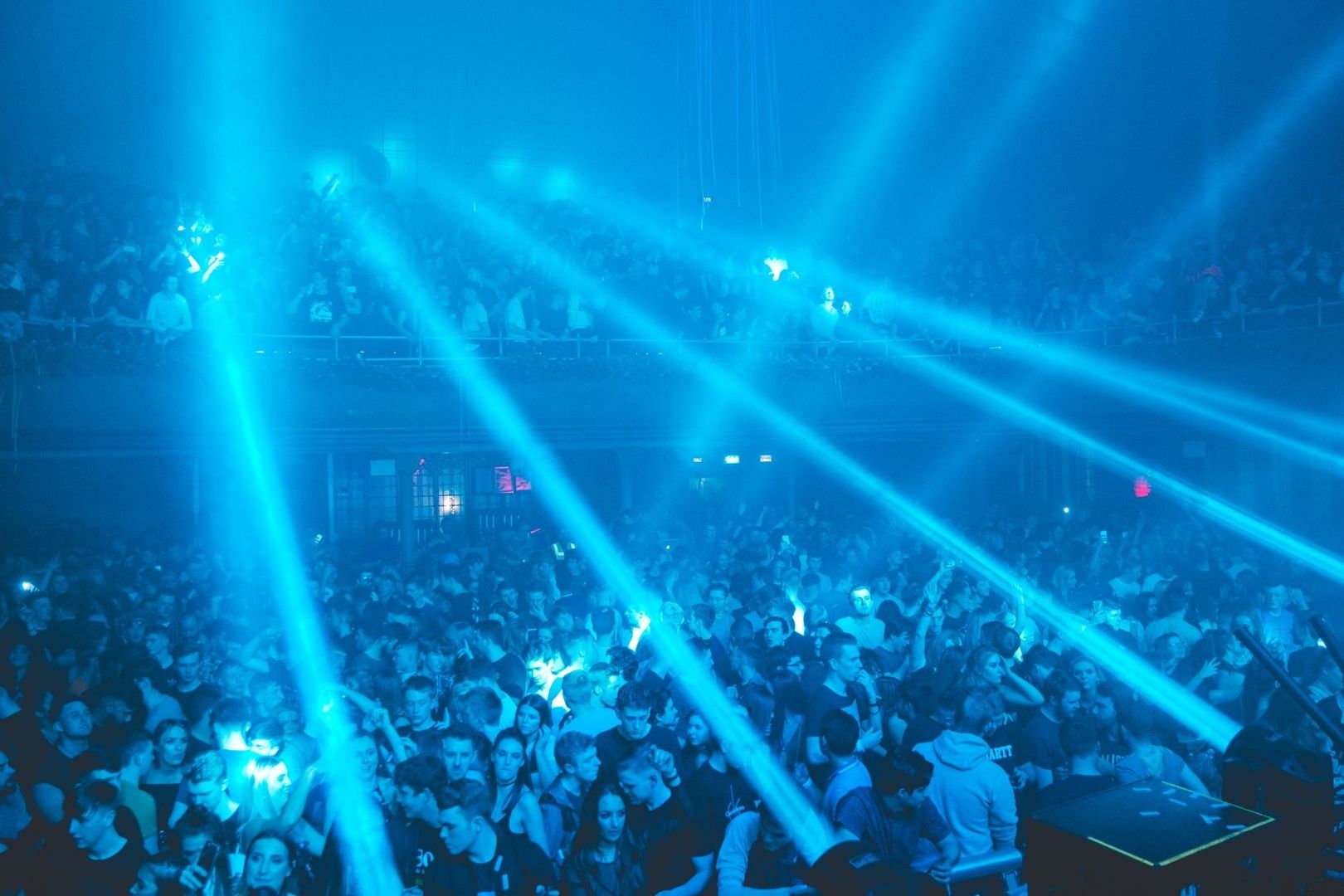
Why Room Acoustics Can Make or Break Your Dance Floor
Why the Best Sound System Cannot Save a Poorly Treated Room
A dance floor rarely empties because the speakers are not powerful enough. More often, people step away because the sound feels tiring, blurry, or physically uncomfortable. Turning up the master output to compensate for weak clarity only increases reflected energy, harshness, and low-frequency buildup. The result is a louder room that feels less exciting, even when the system on paper looks impressive. A carefully planned professional DJ experience depends on making the room work with the music, not forcing the music through an unsuitable space.
Every venue has an acoustic fingerprint shaped by its dimensions, construction, furnishings, and boundaries. Concrete floors, glass, plaster, steel, and parallel walls send sound back toward the audience, sometimes at slightly different times and levels. Those reflections alter bass impact, blur vocal hooks, and make the same track sound powerful in one location and hollow in another. True dance floor energy comes from physical clarity, consistent coverage, and controlled impact, not from maximum amplifier wattage.
The Anatomy of Acoustic Chaos in Event Spaces
Many event spaces are designed to look open, elegant, and flexible rather than acoustically controlled. Bare concrete floors reflect nearly all the energy that reaches them. Glass windows behave similarly, while tall parallel walls can create repeated reflections known as slap echo. A handclap, snare hit, or sharply articulated vocal may bounce between those surfaces long enough to become a distinct metallic repeat. In a DJ set, that extra repetition competes with the next beat and softens the rhythmic definition that keeps people moving.
Reverberation is commonly discussed through RT60, the approximate time required for sound energy to decay by 60 decibels after the source stops. A long RT60 is not automatically bad, but excessive decay makes separate sounds overlap. Midrange information, including vocals, snares, guitar attacks, and melodic hooks, becomes less distinct. Guidance from Vicoustic”s acoustic treatment research describes a controlled mid-frequency reverberation target of roughly 0.3 to 0.6 seconds for listening environments, while emphasizing that treatment must reflect the room”s purpose and geometry. A nightclub may require a different balance, but the principle remains: the room should add atmosphere without swallowing the groove.
Converted warehouses often have high ceilings, steel structures, hard masonry, and very little absorption. Loft venues may combine polished floors with large windows and exposed brick, creating an attractive setting that magnifies reflections. Hotel ballrooms present another familiar challenge. A room such as the Rocklin Ballroom, measuring 56 by 86 feet with 21-foot ceilings, can accommodate large crowds and a dance floor, but its scale also creates long reflection paths and uneven coverage zones. Common architectural pitfalls include:
- Large parallel walls that produce flutter echo and uneven midrange buildup.
- High ceilings that increase reverberation and delay useful direct sound.
- Glass, stone, and polished floors that reflect high and mid frequencies aggressively.
- Open side areas where bass energy escapes or folds back into the main floor unpredictably.
- Empty perimeter spaces that sound radically different once tables, curtains, and guests are added.
Taming Low-End Resonance and Bass Standing Waves
Bass behaves differently from high-frequency sound because its wavelengths are long enough to interact strongly with the room”s dimensions. When reflected waves meet direct waves, they can reinforce one another at some positions and cancel one another at others. These room modes are why bass may disappear near the center of a floor while becoming overwhelmingly loud near a rear wall or corner. Guests can therefore hear entirely different versions of the same kick drum depending on where they stand.
The difficult zone often sits between approximately 100 Hz and 400 Hz. The lower part of that range carries punch and warmth, while the upper portion contains much of the body of bass instruments, toms, synths, and lower vocal information. When too many elements occupy the same space, the mix becomes indistinct rather than powerful. Mixing guidance on reducing muddy low mids identifies a broad problem area extending from roughly 110 Hz to 650 Hz, although the exact trouble frequency must be measured in the specific room. A small, narrow EQ cut can often restore more punch than a broad reduction that makes the entire system thin.
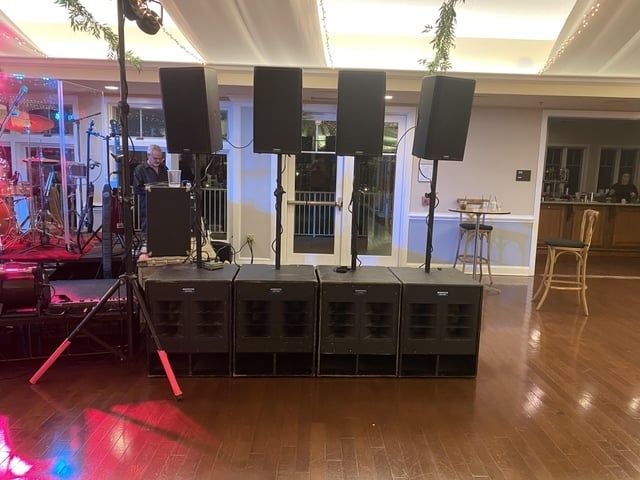
Subwoofer deployment is therefore a placement decision, not simply a purchasing decision. A single sub in a corner may create impressive impact at one position but severe boom elsewhere. Multiple subs arranged across the front of the floor can produce more consistent excitation of the room”s modes. Cardioid or end-fired configurations can reduce rear spill and improve predictability, particularly when the stage or DJ position sits close to walls. The best approach depends on room dimensions, subwoofer design, crossover settings, and measurement results.
| Acoustic problem | Typical symptom | Practical response |
|---|---|---|
| Corner loading | Excessive boom near walls and corners | Move subs away from corners or use a controlled array |
| Center cancellation | Kick and bass nearly vanish at the middle of the floor | Test multiple sub positions and combine sources strategically |
| Low-mid overlap | Bass sounds thick but lacks definition | Use measured parametric cuts and clean overlapping musical parts |
| Rear spill | Back-of-house areas become excessively loud | Consider cardioid deployment and directional processing |
Combating Ear Fatigue to Keep the Crowd Locked in the Groove
Listener fatigue is not simply a matter of personal preference. High sound pressure levels combined with harsh reflections make the ear work harder to identify useful detail. When vocals, percussion, and synth transients arrive directly and then return from hard boundaries, the brain receives competing information. A controlled study published in Noise and cognitive performance research found that exposure to 95 dBA significantly reduced visual and auditory attention in the tested participants. The study used controlled conditions rather than a nightclub, so it should not be treated as a direct prediction for every event, but it reinforces the operational lesson: excessive noise can undermine attention and comfort.
Muddy rooms create a dangerous operating cycle. The DJ hears that the kick is not cutting through, raises the low end, and then increases overall level when the result still feels unclear. The sound system begins to redline, distortion rises, and harsh upper-mid energy becomes more prominent. Guests may not describe the issue technically, but they feel it as pressure, irritation, or the need to move toward the bar or outdoor area. Controlled, precise audio is more persuasive than raw volume, a point also emphasized in modern nightclub sound system design.
The goal is not to make every part of the venue equally loud. The dance floor should carry the rhythmic focus, while the perimeter remains comfortable enough for conversation, drinks, and recovery. This zoning improves the event flow because guests can choose intensity without leaving the venue. Useful practices include:
- Keep main loudspeakers aimed at the active floor rather than reflective rear walls.
- Use delay or fill speakers carefully so secondary zones do not become detached or harsh.
- Monitor the tonal balance at the floor, bar, entrance, and nearest seating area.
- Reduce aggressive upper-mid energy before simply lowering the entire system.
- Set sensible exposure limits and give guests quieter spaces where possible.
The On-The-Ground Acoustic Toolkit for Event Organizers
Event organizers do not always have the budget for permanent construction, but temporary treatment can make a major difference. Heavy pipe-and-drape placed along reflective perimeter walls absorbs a useful amount of mid and high-frequency energy, especially when the fabric is full, dense, and positioned with an air gap behind it. Drapes should not be treated as a complete bass solution, yet they can reduce slap echo and make vocal and percussion detail easier to follow. Rugs, upholstered furniture, tablecloths, ceiling banners, and occupied seating areas also change the acoustic profile.
The audience itself is part of the sound system”s environment. Human bodies absorb substantially more energy than empty chairs and open floor, particularly at mid and high frequencies. A room that sounds bright and reverberant during setup may become noticeably darker once hundreds of people arrive. Sound checks must therefore leave headroom and should be judged from several audience positions, not only from the mixing desk. Venue acoustic guidance from event acoustics specialists recommends mapping sound level, frequency balance, reverberation, and dead spots before selecting treatment or changing equipment placement.
Corrective DSP is valuable, but it should refine a sensible physical setup rather than rescue a fundamentally poor one. Use a calibrated measurement microphone when possible, identify peaks across several positions, and avoid trying to boost deep nulls that are caused by cancellation. During a live sound check, the following sequence keeps decisions practical:
- Place the main speakers and subwoofers for coverage before applying EQ.
- Walk the dance floor and perimeter while playing familiar reference tracks.
- Apply high-pass filters to channels that do not need deep bass, such as vocals, percussion, and many effects.
- Use narrow parametric cuts to reduce measured resonances instead of making broad tonal changes.
- Check crossover alignment, polarity, delay, and limiter behavior at realistic operating levels.
- Repeat the walk-through after the room is populated, then make conservative final adjustments.
Transform Your Venue into an Immersive Sound Sanctuary
Acoustic awareness turns a sound system from a collection of boxes into a complete performance environment. Treating reflections, managing reverberation, distributing sub-bass intelligently, and protecting tonal balance allow the music to arrive with more impact at lower apparent effort. The floor feels punchier because the kick is defined, the bass line remains readable, and the vocal hook survives the room instead of dissolving into its reflections.
Before the next gig, document the venue dimensions, identify its hardest surfaces, and plan a short measurement and listening routine. Test subwoofer positions, bring practical drape or soft treatment where appropriate, and make DSP changes only after placement is working. When the room supports the music, transitions land more cleanly, guests stay engaged longer, and the night develops the kind of immersive atmosphere that brings patrons back.
By Magnus
- 15, Sep, 2026
- 0 Comments